.png?raw=true)
The Hidden Cost Of Preferred Vendors
Source: ClinAI
By Kalyan Obalampalli

Comfort Comes at a Price
We all love comfort. It’s human.
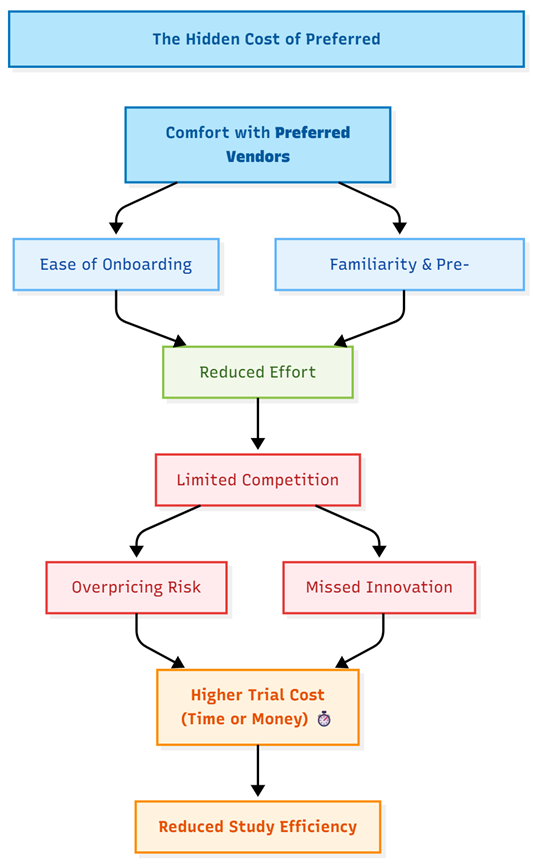
And in clinical trials, comfort often takes the form of preferred vendors.
They’re familiar. Already approved. Easier to onboard.
But here’s the catch:
Comfort can get expensive — not just in dollars, but in innovation, perspective, and opportunity.
You miss fresh thinking.
You miss better timelines.
And you might miss the right fit for your study altogether.
Because that “preferred” list?
It wasn’t built for your protocol.
It was built for speed. For admin. For ease.
But ease ≠ excellence.
A $55 Million Wake-Up Call
A while back, during a roundtable discussion at a clinical operations conference, a head of clinical operations pulled me aside. He said, “Kalyan, I’m managing a $55 million trial, and I’m convinced our CRO is overcharging us.”
My first reaction was simple: How do we know? Surely you reached out to a few other CROs to benchmark the quote?
He sighed. “At my company, I’m not allowed to go to other CROs until they’ve been fully qualified. And to qualify a new CRO, our quality team takes about six months. So, for now, I’m stuck with the one that’s already approved.”
I was stunned.
Here was a well-resourced organization with a full quality department — and yet, the very processes meant to ensure compliance had become an obstacle to operational efficiency.
When Processes Become Barriers
Preferred partnerships are supposed to make life easier. But sometimes, they work against you.
If you can’t compare a quote with the market standard or with other vendors, how do you know you’re getting fair value?
Don’t get me wrong — there are clear advantages to having preferred vendors. You have pre-approved pricing, faster contracting, and reduced onboarding time. But there’s a tipping point where the same process that promises agility ends up costing flexibility — and ultimately, money.
In my view, qualification should happen when a vendor is being seriously considered for partnership — not months before an RFP even goes out. Why qualify every possible vendor upfront when you don’t even know if you’ll ever work with them?
Sometimes, we create rules for ourselves that even we can’t follow.
The SOP Trap Example
I’ve seen this play out in more ways than one.
Years ago, in my early clinical operations days, I wrote SOPs so rigid that even we couldn’t keep up with them. For instance, we required formal meetings with the medical monitor every quarter to review protocol deviations.
In theory, that sounded like a great control. In reality, we could rarely maintain that cadence.
When audits came around, I found myself writing long storyboards to justify why meetings hadn’t happened as prescribed — all to prove that we were compliant with a process we designed but couldn’t realistically follow.
The irony wasn’t lost on me. Sometimes, the systems we design to enforce discipline end up stifling the very efficiency they were meant to protect.
Rethinking “Preferred”
So the next time you receive a “preferred vendor list,” pause and ask yourself:
Is this the best partner for this trial?
Or just the easiest one to engage?
Are we chasing compliance at the cost of competition?
Because sometimes, the real cost isn’t what you spend.
It’s what you didn’t ask.
What We Do at Clin.AI
At Clin.AI, we help sponsors select and manage their vendors more effectively — making it easier to keep studies on track, within budget, and delivered on time. If you’d like to strengthen your vendor oversight and gain real-time visibility into the progress of your trials, give us a call. We’d be happy to walk you through how we can support your goals.
If that resonates with you, we’d love to show you how Clin.AI works. Schedule a Demo
About the Author
Kalyan Obalampalli (KO) is the Founder and President of Clin.AI, a disruptive start-up transforming how biotech and pharma sponsors select and manage vendors. With more than 20 years of leadership experience in clinical operations and outsourcing at major pharma and biotech companies, KO brings a unique perspective on how technology can close long-standing gaps in clinical development.
.png?raw=true)
.png?raw=true)

.png?raw=true)
.png?raw=true)