The 5 Dysfunctions Of Clinical Trial Vendor Selection — And How To Overcome Them
Source: ClinAI
By Kalyan Obalampalli

Having facilitated over $1 billion in vendor contracts across biotech and pharmaceutical sponsors, our team at Clin.AI has observed clear patterns in what drives successful versus stalled partnerships.
Much like Patrick Lencioni’s classic Five Dysfunctions of a Team, vendor selection has its own pitfalls—recurring weaknesses that undermine alignment, trust, and study performance. Recognizing and addressing these dysfunctions early can make the difference between a smooth trial start-up and months of costly course correction.
Here are the five most common dysfunctions of vendor selection—and practical ways to overcome them.
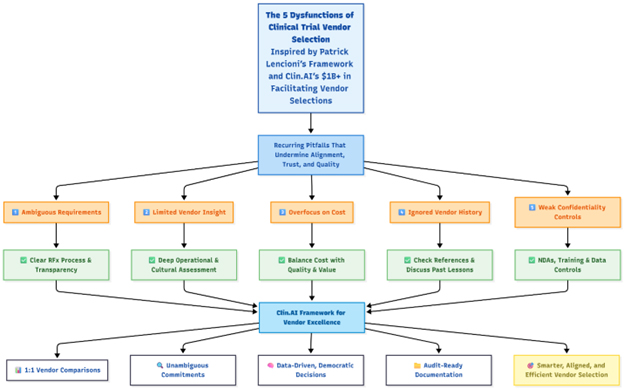
1. Ambiguous Requirements Listing
Problem: Vague or incomplete RFPs lead to mismatched proposals and unrealistic assumptions.
Solutions:
Comprehensive RFx Process: Use structured templates that include protocol synopses, schedules of assessments, and key milestones.
Transparency: Invite questions early; clarity now prevents scope drift later.
2. Inadequate Vendor Insight
Problem: Evaluations often focus on cost tables and overlook how a vendor truly operates.
Solutions:
In-Depth Assessments: Examine governance, escalation models, data systems, and project culture.
Cultural Fit: Assess communication style and flexibility—these determine day-to-day success.
3. Overemphasis on Cost
Problem: Selecting the lowest bidder can compromise quality, timelines, and compliance.
Solutions:
Balanced Evaluation: Weigh financials alongside risk, experience, and delivery consistency.
Long-Term Vision: Consider total value over contract lifespan, not just the opening price.
4️. Insufficient Vendor History Review
Problem: Failing to analyze past performance increases the risk of repeat issues.
Solutions:
Reference Checks: Speak directly with prior clients about reliability and communication.
Open Dialogue: Ask vendors how they resolved challenges in similar studies.
5. Neglecting Confidentiality Concerns
Problem: Weak data-protection practices threaten study integrity and sponsor IP.
Solutions:
NDAs Before Details: Always execute confidentiality agreements first.
Training & Controls: Ensure all contributors—internal or external—understand data-handling obligations.
Building a Stronger Vendor-Selection Culture
Vendor selection is more than procurement—it’s relationship architecture. Success depends on precision, engagement, and shared accountability.
At Clin.AI, we help sponsors apply these principles with:
Straightforward 1:1 Vendor Comparisons
Unambiguous Commitments
Data-Driven, Democratic Decision Frameworks
Audit-Ready Documentation
Once the right vendors are chosen, our platform continues to support ongoing vendor management, ensuring trials stay compliant, efficient, and on budget.
What We Do at Clin.AI
At Clin.AI, we help sponsors select and manage their vendors more effectively — making it easier to keep studies on track, within budget, and delivered on time. If you’d like to strengthen your vendor oversight and gain real-time visibility into the progress of your trials, give us a call. We’d be happy to walk you through how we can support your goals.
If that resonates with you, we’d love to show you how Clin.AI works. Schedule a Demo
About the Author
Kalyan Obalampalli (KO) is the Founder and President of Clin.AI, a disruptive start-up transforming how biotech and pharma sponsors select and manage vendors. With more than 20 years of leadership experience in clinical operations and outsourcing at major pharma and biotech companies, KO brings a unique perspective on how technology can close long-standing gaps in clinical development.
.png?raw=true)
.png?raw=true)

.png?raw=true)
.png?raw=true)